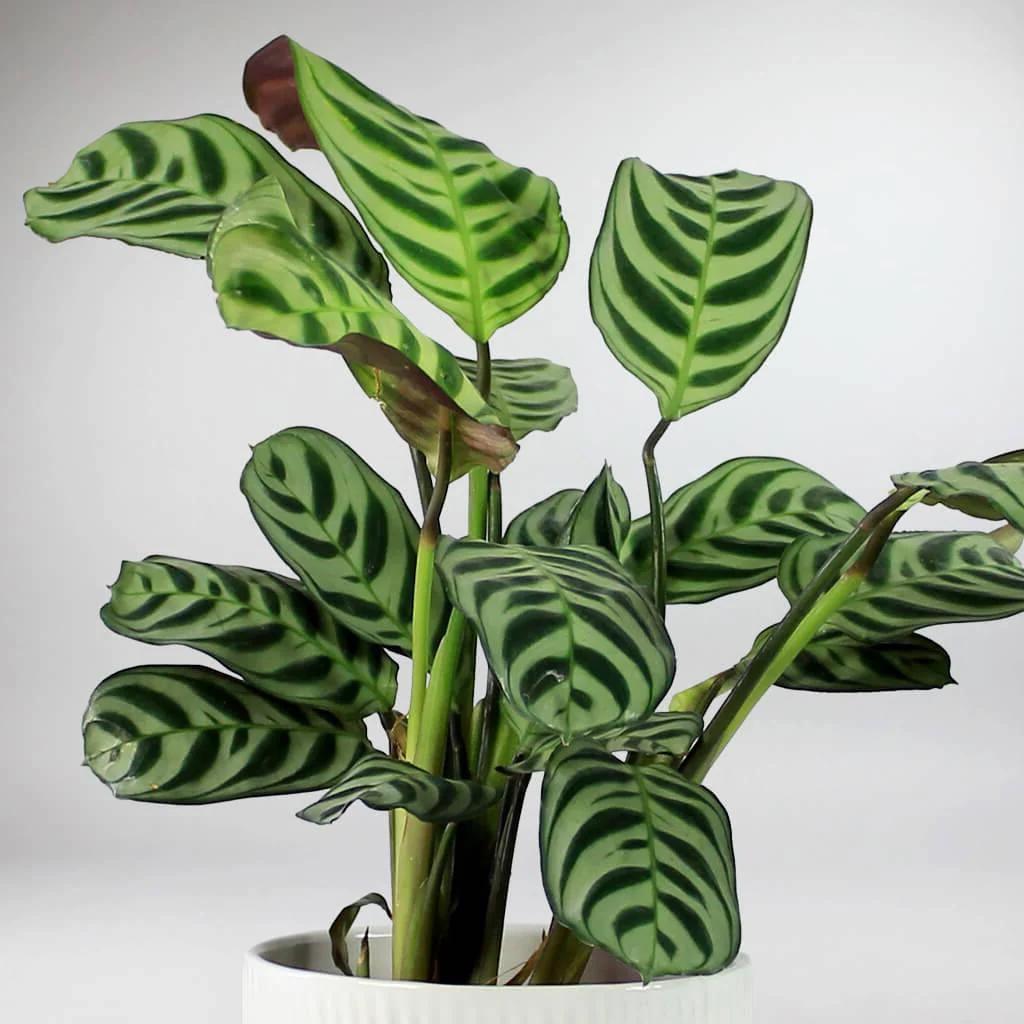
This striped calathea was named in honour of Brazilian landscape architect Roberto Burle Marx.
The Ctenanthe is a plant native to tropical Central and South America. It is closely related to the Calathea and has the same nice characteristic that the plant raises its leaves at night. This means you see the beautiful striped top of the leaves during the day, and the beautiful purple underside at night. So don’t be alarmed if you hear some rustling at night: these are leaves sliding past each other!
Care guide
The Ctenanthe Burle Marxii is easy to care for. Place the plant in a light spot but not in direct sun. Keep the soil slightly moist and give small amounts of water preferably once or twice a week. Do not let the soil dry out too much. Try to keep the position of the Ctenanthe the same as much as possible. This is because the plant is quite sensitive to relocation. If you take good care of the plant, it can produce an awful lot of new leaves!
Nutrition
Apply a weak dose of a nitrogen rich foliage fertiliser once or twice a month during the growing season.
Additional information
Toxicity
Another advantage of the Ctenanthe is that it is non-toxic to pets and children.
Like other calatheas, this plant has top air-purifying qualities.
Its circadian rhythms produce more oxygen at night, promoting a better night’s sleep and contributing to the health of your Respiratory System
Acts as a Natural Humidifier, creating a healthier and more comfortable environment in your home.
Gallery